COBRA Is Not Your Only Option: Affordable Alternatives After Losing Job Coverage
Why most people are better off with an ACA Marketplace plan — and how to switch quickly.
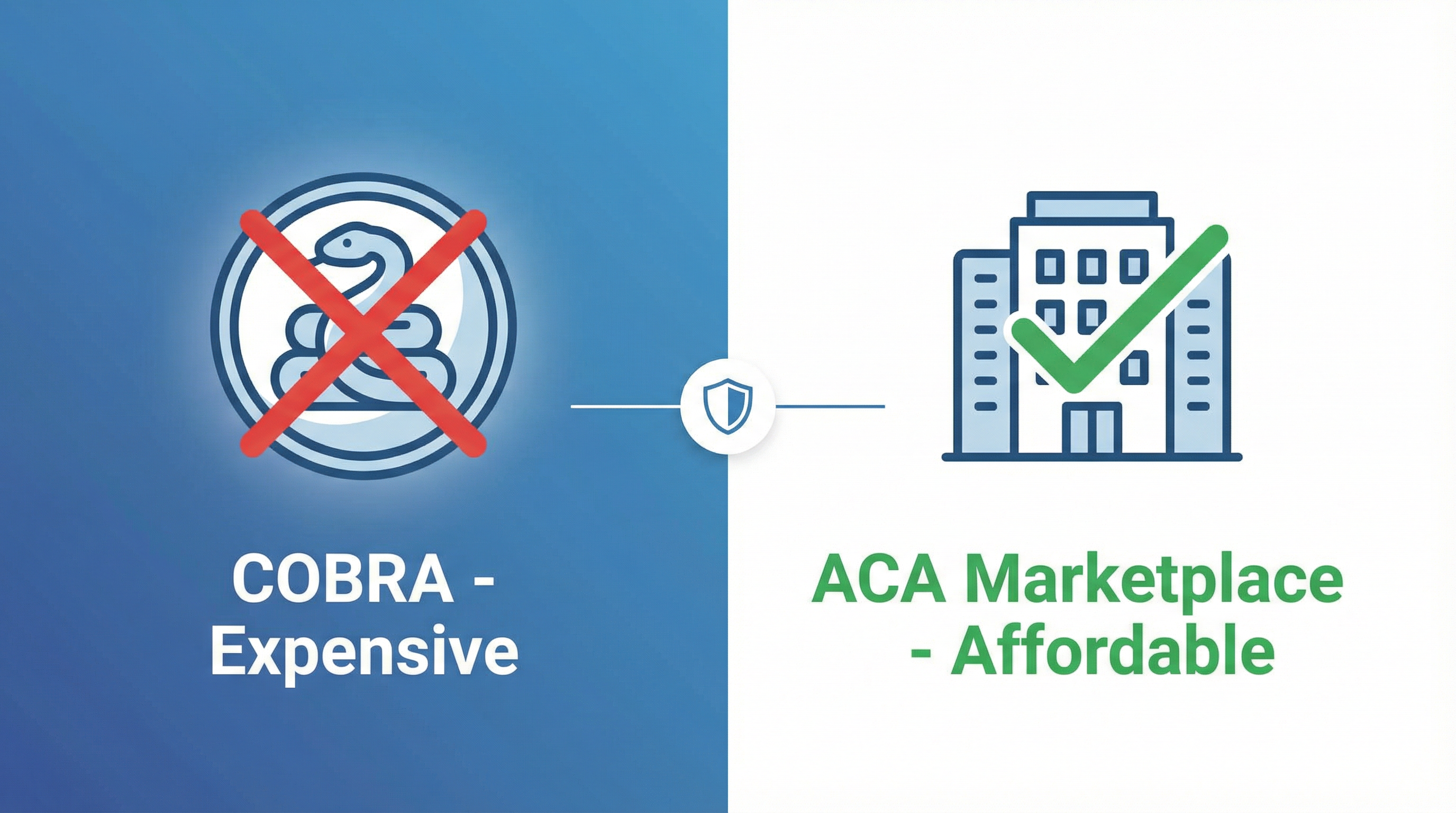
What Is COBRA and Why Is It So Expensive?
COBRA — the Consolidated Omnibus Budget Reconciliation Act — is a federal law that allows you to continue your employer-sponsored health insurance after leaving a job, for up to 18 months (or longer in certain circumstances). The coverage is identical to what you had while employed, which sounds appealing. The problem is the cost.
When you were employed, your employer likely paid a significant portion of your monthly premium — often 70% to 80% of the total cost. Under COBRA, you are responsible for the entire premium — both your share and your employer's share — plus a 2% administrative fee. This can result in a monthly premium of $600 to $800 for an individual or $1,500 to $2,000 or more for a family, depending on your previous plan.
COBRA vs. ACA Marketplace: A Direct Comparison
| Feature | COBRA | ACA Marketplace Plan |
|---|---|---|
| Monthly Cost | Very High (full premium + 2% fee) | Low to Moderate (subsidies often available) |
| Financial Assistance | None | Premium tax credits + CSRs available |
| Coverage | Identical to your previous employer plan | Comprehensive; covers 10 essential benefits |
| Provider Network | Same network as your old plan | Varies by plan; choose what fits your needs |
| Duration | Up to 18 months | Ongoing annual coverage |
| Pre-Existing Conditions | Covered | Covered |
| Enrollment Window | 60 days from loss of coverage | 60-day Special Enrollment Period |
Why the ACA Marketplace Is Usually the Better Choice
For the vast majority of people who lose job-based coverage, an ACA Marketplace plan is significantly more affordable than COBRA, especially when you factor in premium tax credits. When you lose your job, your income often drops — and a lower income means a higher subsidy on the Marketplace.
Consider a single adult who was paying $200/month for their share of employer coverage. After losing their job, COBRA might cost them $650/month for the same plan. But if their projected annual income drops to $35,000, they might qualify for a subsidized ACA Silver plan for as little as $50–$150/month — with comparable or better benefits.
The Key Insight: Losing your job is a Qualifying Life Event that triggers a 60-day Special Enrollment Period on the ACA Marketplace. You do not have to wait for Open Enrollment. You can compare plans and enroll within 60 days of losing your coverage.
When COBRA Might Actually Make Sense
COBRA is not always the wrong choice. There are specific situations where it may be worth the higher cost:
- You are in the middle of treatment for a serious condition and your current doctors and specialists are not in any available Marketplace plan network. Continuity of care can be worth the premium difference.
- You expect to find a new job quickly (within 1–2 months) and want to avoid the administrative process of switching plans twice in a short period.
- Your income is too high to qualify for subsidies and the COBRA plan has a significantly better network or benefits than available Marketplace plans.
Even in these cases, it is worth getting a quote from the Marketplace before committing to COBRA. You have 60 days to decide, and you can elect COBRA retroactively if you need to — meaning you can wait to see if you need care before paying the first premium.
Other Alternatives to COBRA
Medicaid
If your income drops significantly after job loss, you may qualify for Medicaid, which provides free or very low-cost coverage. You can apply for Medicaid at any time of year — there is no enrollment period. If you are approved, coverage can begin almost immediately.
Spouse's or Partner's Employer Plan
Losing your job is a Qualifying Life Event that allows your spouse or domestic partner to add you to their employer-sponsored plan outside of their own open enrollment period. This is often the most seamless and affordable option if it is available to you.
Short-Term Health Insurance
Short-term plans can bridge a very brief gap in coverage, but they are not ACA-compliant, do not cover pre-existing conditions, and have significant benefit limitations. They should be a last resort, not a primary option.
How to Enroll in an ACA Plan After Losing Coverage
- Act within 60 days. Your Special Enrollment Period begins the day you lose coverage. The sooner you enroll, the sooner your new coverage begins.
- Gather documentation. You will need proof of your loss of coverage, such as a letter from your former employer stating your last day of coverage.
- Estimate your new income. If your income has changed due to job loss, use your projected income for the rest of the year. This will determine your subsidy amount.
- Compare plans on the Marketplace. Look at the premium after your subsidy, the deductible, and whether your doctors are in-network.
- Enroll and confirm your start date. Coverage typically begins on the first day of the month after you enroll.
Our licensed agents can walk you through this process quickly and help you find the most affordable plan for your new situation. Call 888-982-0356 — we can often have you enrolled in under 30 minutes.
Ready to Find the Right Health Plan?
Our FFM-certified agents are standing by to help you compare plans, calculate your subsidies, and enroll in minutes. There is no cost to use our service.
Get Free Quote Now Call 888-982-0356